
UK Investment Casting Prototyping
The Technical Advantages of 3D Printed Wax Patterns vs Traditional Tooling
For manufacturers, the decision between 3D printed wax patterns and traditional hard tooling isn’t only about cost – it’s about lead time, design freedom, and manufacturing efficiency.
At Lestercast Ltd, we’ve been delivering rapid prototyping solutions for over 30 years, making us one of the early adopters of this technology within the UK investment casting sector. That experience, combined with our latest high-speed 3D wax printer, allows us to offer significantly improved turnaround times and surface quality compared to earlier systems.
Below is a technical comparison to help buyers and engineers understand the real advantages of 3D printed wax patterns.

3D Printed Wax Patterns vs Hard Tooling
Lead Time Reduction
Traditional Tooling:
Tool design and manufacture: 2-6+ weeks
Sampling and validation required before production
3D Wax Printing:
Direct-from-CAD pattern generation in hours
Total casting lead time reduced to as little as 5 days
From a total manufacturing timeline/process standpoint, this eliminates the tooling stage entirely, utilising Additive Manufacturing to compress the development cycle.
Technical Impact:
Reduced time-to-market and faster iteration cycles for UK manufacturing programmes.

Cost Structure
Traditional Tooling:
- High upfront tooling costs (£1,000s depending on complexity)
- Additional costs for tool modifications
3D Wax Printing:
- Pattern cost reduced to a very small cost per unit
- No capital expenditure on tooling
Technical Impact:
Ideal for low-volume production, prototyping, and/or intermediate manufacturing – aligning with Design for Manufacturing principles by reducing waste and upfront costs.

Design for Manufacture (DFM) & Iteration
Traditional Tooling:
- Design changes require tooling rework, including full or partial replacement.
- Any changes to the existing tooling mean delays in manufacture, plus generating buffer stocks of previous iterations may be necessary to ensure product continuity or availability.
3D Wax Printing:
- Designs can be realised without the immediate need to consider tooling design/constraints.
- Multiple versions can be printed in parallel, allowing for direct / instantaneous comparison.
Technical Impact:
Enables real-time optimisation of gating, wall thickness, and geometry before production tooling is committed.

Material Flexibility
Traditional Tooling:
- Tooling must account for alloy-specific contraction rates
- Changing material / alloy group usually requires a complete re-cut of the tooling
3D Wax Printing:
- Material changes handled via CAD scaling factors
- Differing contraction rates can be applied to individually printed components with the same build file.
Technical Impact:
Faster validation across multiple alloys, supporting compliance with UK and international material standards.
Geometric Complexity
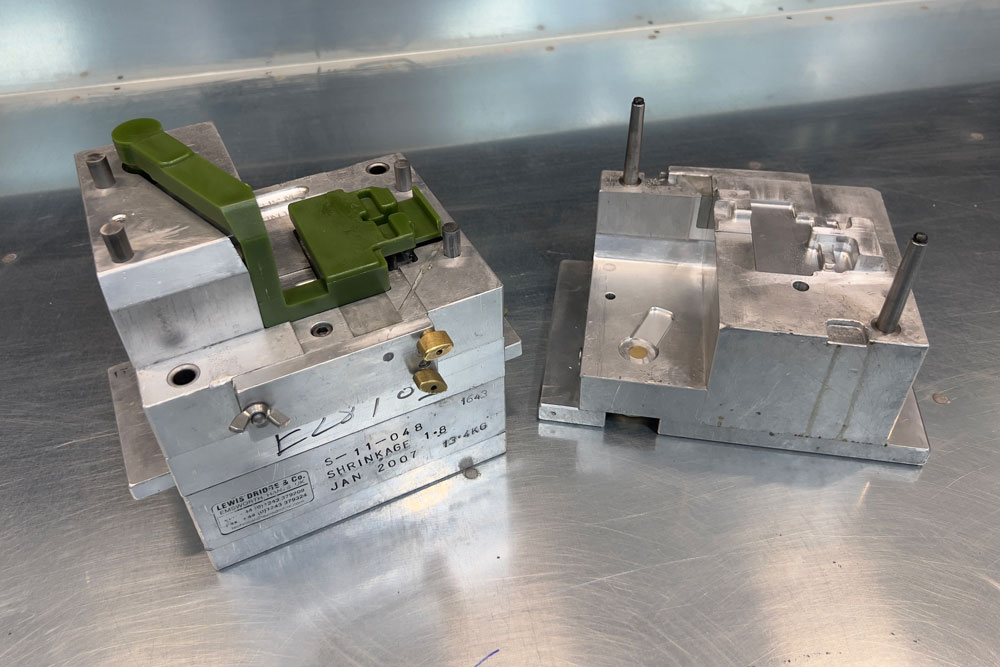
Traditional Tooling:
- Limited by tool split lines, draft angles, and ejection constraints
- Complex internal features require temporary cores, which require their own tooling in order to manufacture them. Removable inserts are required.
3D Wax Printing:
- No tooling constraints
- Capable of producing complex geometries, including:
- Internal channels
- Thin walls
- Lattice or honeycomb inner support structures, which reduce the amount of wax required to form the shape.
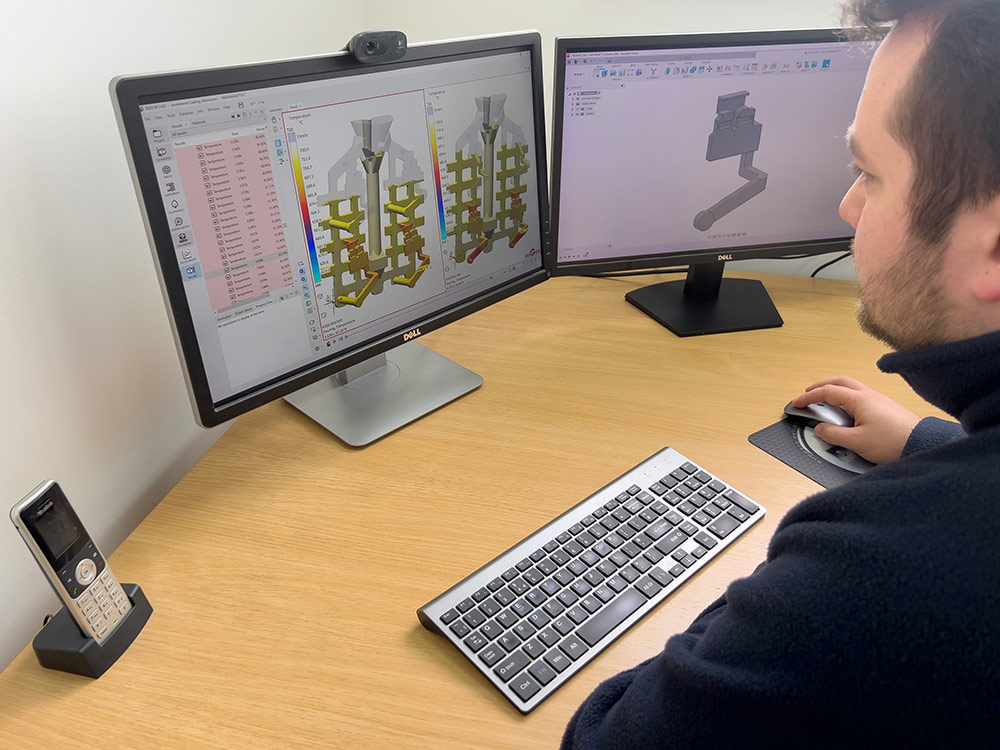
With the increasing use of Topology Optimisation and AI to generate efficient designs, these are often better suited to being formed by 3D printing. In these cases, the costs and constraints associated with traditional tooling may not be compatible.
Technical Impact:
Improved performance-to-weight ratios and the design freedom to accurately replicate an optimum.
Surface Finish & Accuracy
Traditional Tooling:
- High-quality surface finish from injection-moulded wax
- Proven dimensional consistency
Previous Rapid Prototyping Systems:
- Slower build speeds
- Inferior surface finish requiring additional post-processing
- Typical surface resolution / layer thickness of 42µm
Latest 3D Wax Printing at Lestercast:
- Significantly improved surface resolution / layer thickness of 14µm
- Surface finish is now comparable to injection-moulded wax.
- Enhanced dimensional accuracy and repeatability
- Build speeds are upto x3 faster than previous technology.
- Wax support structures use 50% less material, meaning faster post-processing
Technical Impact:
Reduced finishing operations and improved as-cast quality.

Proven Capability Backed by Experience
While many foundries are only now adopting rapid prototyping, Lestercast Ltd has been refining these processes for over two decades.
This means:
- Established process control and reliability
- Deep understanding of casting behaviour
- Consistent, production-ready results
Our recent investment in next-generation equipment builds on this foundation – delivering faster turnaround and superior surface quality than earlier technologies.

Supporting UK Industry with Confidence
Case Studies & Proven Results
Our case studies demonstrate:
- Reduced development lead times
- Successful transition from digital concept, to physical prototypes, to production volumes
- Complex precision casting solutions delivered efficiently

Customer Testimonials
- UK manufacturers trust us for:
- Reliability and responsiveness
- Technical expertise
- Consistent casting quality

ISO-Certified Quality
Lestercast Ltd operates to recognised ISO standards, ensuring:
- Process consistency
- Full traceability
- Compliance with industry requirements
Summary: Why Choose 3D Wax Printing?
Compared to traditional tooling, 3D printed wax patterns offer:
- Lead times reduced from weeks to days
- No tooling costs
- Rapid design iteration
- Greater geometric freedom
- Flexible material selection
- Production-quality surface finish (with latest technology)
For UK buyers, this translates to lower risk, faster development, and improved product performance.
Start Your Project Today!
If you’re looking for UK investment casting prototyping with advanced 3D wax printing, Lestercast Ltd provides the experience and technology to deliver.
👉 Speak to our technical team